

Potential Tear Biomarkers For The Diagnosis Of Parkinson’s Disease—A Pilot StudyⅡ
Mar 02, 2023
3. Results
3.1. Patients and Clinical Parameters
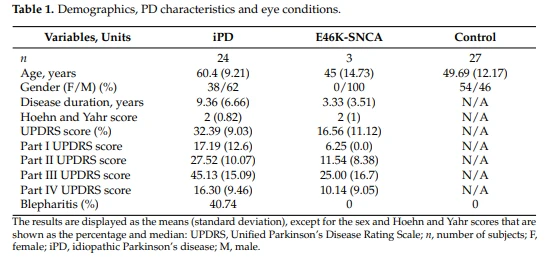
Between March 2019 and October 2019, 24 patients with iPD, three symptomatic carriers of the E46K-SNCA mutation, and 27 CT subjects were included in this pilot study, whose general characteristics are presented in Table 1. The PD patients’ mean disease duration was 9.36 years, and they had mild bilateral motor disability (UPDRS score) and Hoehn and Yahr scores that suggested mild-to-moderate motor impairment. A characteristic of IPD patients was that 40% of them had mild-to-moderate blepharitis.
3.2. nLC MS/MS Data A total of 560 tear proteins were identified in the samples analyzed here, by previous proteomic studies on tears, and several group-specific tear proteome alterations were evident in the PD patients relative to the CTs. Proteins with different abundance with previous proteomic studies on tears, and several group-specific tear proteome alterations were evident in the PD patients relative to the CTs. Proteins with different abundances were detected in both groups, although most of the deregulated proteins in the tear proteome of PD patients were overexpressed. An analysis of the STRING PPI network was performed to evaluate the interactions between proteins that differed significantly in the PD patients and CTs (Figure 1). Proteins that were overexpressed in PD patients were implicated in significantly more interactions than expected, indicating g that the increases in those proteins have some biological connection (Figure 1A). However, weaker relationships were observed between the proteins that were downregulated, representing a differentiated cluster (Figure 1B). Most of the differentially expressed proteins could be localized to either the extracellular or intracellular compartments.

To better understand the potential role of the differentially expressed proteins in a biological context, functional annotation analyses were performed with different gene ontology (GO) terms. As a result, deregulated proteins were seen to be involved in different biological processes (Figure 2): the immune response (lipocalin 2—LCN 2, serpin B3—SPB3, follicular dendritic cell secreted peptide—FDSCP, cadherin—MFGM and neutrophil gelatinase-associated lipocalin—NGAL); apoptosis (olfactomedin-4—OLFM4, caspase-14—CASPE and gamma-glutamyl cyclo transferase—GGCT); inflammation (Calprotectin-S100A8, S100A9); collagen degradation (myeloblastic—PRTN3 and metalloproteinase 9—MMP9); protein synthesis (heterogeneous nuclear ribonucleoprotein A3—ROA3); keratinocyte differentiation (calmodulin-like protein 5—CALML5); lipid transport (apolipoprotein D—APOD, apolipoprotein A2—APOA2 and low-density-lipoprotein-related protein 2—LRP2); and defense (myeloperoxidase—MPO, defensin alpha 3—DEFA 3, glutathione peroxidase 3—GPX3, chitinase-3-like protein 2—CH3L2 and lysozyme C—LYSC).

If the PD patients were considered all together, and separately as iPD patients and patients with the E46K-SNCA mutation, upregulated tear proteins were evident in all three of these groups, with their expression varying in each (Figure 3). It should be noted that only three patients carrying the E46K-SNCA mutation were studied, and the dispersion of the data from then was greater. The same proteins were more strongly expressed in the tears of patients with the E46K-SNCA mutation than in the tears of patients with iPD. All of these comparisons were made on the values relative to those of the CT tear samples.

Table 2 shows the proteins that were upregulated (fold > 1.5) and downregulated (fold < 0.5) in the IPD group with blepharitis when compared with IPD patients without blepharitis. Patients with the E46K-SNCA mutation did not develop blepharitis.

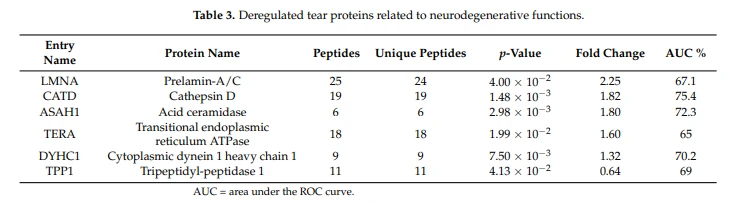
Among the tear proteins deregulated in PD patients, a group of six proteins stood out, five of which were overexpressed in the PD group relative to the CTs (prelamin A/C—LMNA, cathepsin D—CATD, acid ceramidase—ASAH1, transitional endoplasmic reticulum ATPase—TERA and cytoplasmic dynein 1—DYHC1), whereas one of them was downregulated (tripeptidyl-peptidase 1—TPP1: Table 3). These proteins were associated with neurodegenerative processes, mainly alterations in lysosomal autophagy, apoptosis, retrograde axonal transport, and demyelinating processes. It was interesting to note the relationship of these proteins with alterations in lysosomal function. Of the six proteins, three presented a good capability to correctly classify PD patients and CTs, as reflected by the AUC values of the ROC curves, and they were related to alterations in lysosomal function: CATD, ASAH1, and DYHC1.
The univariate logistic regression analysis identified four variables with statistical significance at α = 0.05: the age of the patients and the fold change in CATD, ASAH1, and DYHC1 proteins (Table 4).

In addition, the LMNA and DYHC1 proteins were seen to have statistical significance at α = 0.1. A multivariate logistic regression model was established by considering age and proteins with any significance level. While the general model only showed significance in the case of the CATD protein (Table 5), the model was likely to have been affected by the small number of samples available, and increasing the number of samples studied might well identify other significant variables.

4. Discussion
The present study was carried out to analyze proteins by nano-liquid chromatography–mass spectrometry (nLC–MS/MS) and select those related to neurodegenerative diseases that had a higher discriminatory power between the PD and TC groups studied. Several searches for candidate biomarkers in the tears of PD patients have been performed in recent years; however, the conclusion was that further validation studies were needed to find the best candidate diagnostic or prognostic biomarker for this pathology. The diagnosis of PD is currently based on the presence of motor and non-motor symptoms, including sleep disturbances or olfactory deficits. Motor symptoms appear mainly when the loss of dopaminergic neurons reaches around 50–60%.

Click to life extension cistanche for Parkinson's disease
Therefore, achieving an early diagnosis will
open the way to modify the course of the disease and hopefully delay the severe disability
caused by this pathology. This issue has become a key aspect in PD research, although
the lack of valid biomarkers represents a major obstacle that prevents the identification of
patients in preclinical or prodromal stages, as well as the monitoring of the evolution of the disease and the effects of treatments.
For this reason, the present study set out to search for a reliable biomarker of PD in a noninvasive fluid, such as tears. The eye has many neural and vascular elements that are also found in the brain, making it ideal for the discovery of new biomarkers that could be used to diagnose PD or other neurodegenerative diseases, as well as in the discovery of new therapeutic targets. Here, tears from PD and CT patients were obtained through glass capillaries without prior anesthesia and without touching the ocular surface. Previous pilot studies on patient tears have been performed with a group of patient tears [19], and our analysis is the first individual tear analysis that will allow for the identification of specific individual markers. By using capillaries to obtain the tear samples, we avoid touching the conjunctival epithelium, thus discriminating proteins found in the tear from conjunctival proteins, as occurs with the use of Schirmer strips. In our study, we found significantly deregulated proteins in PD patients.
These proteins are mainly involved in inflammatory and neurodegenerative processes, apoptosis, and immune responses. Inflammation is ubiquitous in neurodegenerative diseases, including PD, and recent studies have identified that α-syn-derived T-cell epitopes are preferentially recognized in PD patients, as well as T cells in PD target regions, possibly suggesting an autoimmune component of PD [20]. Neurons were thought to be protected from autoimmune attack, but dopaminergic neurons are vulnerable because they have proteins on their cell surface that help the immune system recognize foreign substances [21]. T cells can potentially mistake disease-damaged neurons for foreign substances, and, as a result, Sulzer et al. proposed a model in which α-syn-specific T cells cause neuronal death in neurodegenerative diseases associated with specific misfolding of this protein. In our study, groups of deregulated proteins related to immune response, such as LCN2, SPB3, and FDSCP, among others, were observed in tear samples. However, certain immunoglobulins involved in immune response, such as IgA2, did not present statistically significant differences between the PD group and the CT group.

Further studies are needed to elucidate whether this relationship between immune response and proteins found in tears is directly related to PD. Neuroinflammation can be defined as a non-specific inflammatory event in the brain, and the entire CNS has a neuroinflammatory component, which is evident in diseases such as Multiple Sclerosis (MS), brain aneurysms and cerebrovascular accidents, epilepsy, AD and PD, and in which the activity of extracellular matrix (ECM) degrading enzymes or metalloproteases (MMPs) has been implicated. MMPs participate in many physiological and pathological processes in the brain and blood. The blood–brain barrier (BBB) is formed by the endothelial capillaries that separate the blood supply to the brain, and its function resides in three structures that are critical to its integrity: the endothelial cells of the brains capillaries, the tight junctions (TJs) between these cells, and the basement membrane. The endothelium is a barrier to small hydrophilic compounds as the TJs seal the gaps between the adjacent endothelial cells, impeding the uncontrolled passage of solutes between these cells and converting the brain endothelium into a relatively impermeable barrier [22,23].
However, the basement membrane connects these endothelial cells to pericytes and astrocytes to form the neurovascular unit that facilitates communication between the cells. This membrane is fundamental for the BBB to function adequately and, as such, for brain homeostasis and its general health. It has been proposed that MMPs specifically disrupt TJs, and they digest the basement membrane of the endothelium, thereby contributing to certain brain diseases [24]. While it is technically difficult to demonstrate MMP activity in vivo, stronger MMP activity was associated with greater BBB permeability following a cerebrovascular accident and during reperfusion in vivo [25]. An increase in MMP-2 and MMP-9 mRNA and activity has been described after reperfusion in hypertensive rats with medial cerebral artery occlusion (MCAO) [26]. Moreover, BBB leakage was also detected in the piriform cortex of these rats, in conjunction with the disruption of TJs, indicating that these MMPs alter BBB integrity by degrading TJ proteins [26]. As such, and despite the technical challenges, there is some evidence that MMPs digest TJ and ECM proteins in vivo.

The expression and activity of MMP-1, -2, and -9 have been determined in postmortem brain tissue from PD patients, and while no changes were observed in MMP-1 and MMP-9 relative to aged-matched controls, a 50% reduction in MMP-2 activity was evident in the SN of the PD patients [27]. It was proposed that the weaker MMP 2 activity could help the dopaminergic neurons and their neurites survive in the SN [27]. Moreover, MMP-3 has also been studied about PD, which could potentially be implicated in the cleavage of α-syn. MMP-3 cleaves purified α-syn in vitro and the aggregation of α-syn augments in the presence of MMP-3 aggregates that would be particularly damaging to dopaminergic cells in PD. Significantly, MMP-1, -2, and -9, and MT1-MMP also cleave purified α-syn, albeit less efficiently than MMP-3 [28]. MMP-3 appears to be involved in dopaminergic neurodegeneration, neuroinflammation, and BBB integrity in PD; however, further studies will be required to clarify the role of all of these MMPs in PD and whether their specific inhibition could represent a valid therapeutic strategy. Here, MMP-9 levels were higher in the tear of PD patients, both iPD patients (2.8-fold) and those that carry the E46K-SNCA mutation (3-fold).
The latter PD patients did not develop blepharitis, thus suggesting that the increase in MMP-9 concentrations is not as strongly associated with blepharitis as with the pathology of PD. However, analyzing the iPD groups separately, we see that there is stronger MMP-9 overexpression in IPD patients with blepharitis, 3.08 times that in IPD patients without blepharitis. We previously studied the contribution of this MMP to the tear in patients with pathologies of the ocular surface [29,30]. However, further studies will be necessary to determine if the increase in MMP-9 is directly related to PD or ocular surface pathologies that could alter the tear analysis.
Evidence is accumulating on the important role of energy metabolism in neurodegenerative diseases, including PD. Abnormal lipid fractions and lipid peroxidation have been assessed in PD patients [31], and, as a result, lipid fractions were proposed as possible protective biomarkers of PD. Recent epidemiological studies on a prospective cohort or with case-control designs attempted to assess the associations between lipid fractions and the risk of PD [32–35]. Some of these studies had small sample sizes, while others only examined specific lipid fractions, mainly cholesterol, or controlled for a limited number of potential confounders. Although a consistent association has been seen between higher cholesterol levels and a lower risk of PD, the underlying cause is unknown, and whether similar results are seen for other lipid fractions should be assessed. In the tear samples tested here, members of the apolipoprotein (APO) family appear to be deregulated, a family of proteins implicated in many neurodegenerative disorders. The APOE protein participates in several brain disorders, including AD, MS, traumatic brain lesions, and Creutzfeldt–Jakob disease [36–38], raising the possibility that ApoE may also play a significant role in the development of PD. Furthermore, higher cholesterol levels were detected in the brain of a transgenic mouse model of PD, and since APOs are involved in maintaining cholesterol homeostasis, a possible association between APOs and PD could exist [39].
However, few studies have focused on the role of APOs in PD. In the CNS, APOs are produced by glial cells and they are taken up by neurons to be used in axon growth and for synaptic activity. Furthermore, ApoE is thought to have a neuroprotective role, preventing the apoptosis of neurons and retinal ganglion cells (RGCs) [40]. The expression of APOs in the human brain is influenced by the type of APO and the individual’s age. Of the different APOs, ApoE, ApoD, and ApoJ are the most strongly expressed in the brain. However, their levels of expression could change at different stages of life and, for example, there is 50% more ApoE in the neonatal brain than in that of an adult, while there is approximately 10 times more ApoD and ApoJ in the adult brain than in that of the embryo. ApoD is expressed principally in the brain, peripheral nerves, placenta, lung, ovary, and spleen [41]. In our tear samples, ApoD appears to be overexpressed in patients with PD. Glial cells close to the SN of PD patients have more ApoD, which is thought to be related to oxidative stress, as ApoD protects cells from oxidative stress, and its enhanced expression inhibits lipid peroxidation [42].

Indeed, ApoD’s expression in the brainstem appears to protect against neurodegeneration, and in damaged brains, neurons do not express ApoD [41]. Thus, ApoD in the tear warrants further studies in PD patients and those with other neurodegenerative diseases to assess whether it has a true neuroprotective effect in such patients. Among other proteins found to be deregulated in the present study, a small group was selected due to their involvement in neurodegenerative processes, specifically in lysosomal autophagy or neuronal transport. The ubiquitin-proteasome (UPP) pathway has been proposed to play a key role in the degradation of α-syn [43]; however, there is growing evidence that the lysosome may also mediate the degradation of α-syn [44,45]. Regardless of the exact autophagy pathway by which α-syn enters the lysosome, it is assumed that it is rapidly degraded by “synucleinase” under normal conditions. In dopaminergic neurons, there is a dynamic equilibrium between the various conformational forms and oligomeric states of the α-syn protein, which is modulated by factors that can accelerate or inhibit the aggregation and formation of fibrils [46]. The identification and characterization of the toxic α-syn species are still incomplete, and many studies have focused on different states of protein aggregation.
These studies attempted to determine if the toxic species correspond to the insoluble fibrillary proteins found mainly in the LBs or, conversely, to the pre-fibrillary protein oligomers or protofibrils. There is increasing evidence in vivo and in vitro that oligomeric species are the most pathologically relevant isoforms [47,48], and it has even been proposed that LBs could be protective, representing a form of aggresome. In physiological circumstances, α-syn is active at synapses and it is involved in processes such as the formation, trafficking, and coupling of synaptic vesicles (SVs). It is also associated with the recycling of SVs and the storage of dopamine.
The phosphorylation and dephosphorylation of α-syn drive the activation and deactivation of this protein, which is also controlled by lysosomal autophagy and proteasome degradation driven by ubiquitinylation [49]. In pathological conditions provoked by different stimuli, α-syn undergoes incorrect folding, mutation, or phosphorylation that leads to its aggregation, affecting the formation and coupling of lysosomal vesicles without producing lysosomal autophagy, and leading to its deposition in dopaminergic neurons, the formation of LBs and apoptosis [49]. The results presented here show that, among the proteins deregulated in the tear fluid of PD patients, both iPD patients and carriers of the E46K-SNCA mutation, there are two proteins related to lysosomal autophagy: CATD and ASAH1. CATD is an important lysosomal aspartyl protease, and, interestingly, CATD deficiency and its enzymatic inactivation in humans result in an early onset of progressive and eventually fatal neurodegeneration, which is classified as one of several neuronal ceroid lipofuscinoses (NCL) syndromes [50,51]. In vitro, CATD produces partial proteolysis of recombinant α-syn [52], and the ability of CATD to regulate α-syn has been evaluated in wild-type and mutant dopaminergic cells in culture.
Moreover, the brains of several CATD-deficient mammals with NCL were studied to assess endogenous α-syn processing, and, consequently, it was concluded that the enzymatic activity of CATD plays an important role in the metabolism of α-syn. The ASAH1 protein is a lysosomal enzyme that converts lysosomal ceramide to sphingosine. Inhibition of ASAH1 increases ceramide levels, also reducing the amount of oxidized α-syn and that of the ubiquitinylated protein in dopaminergic neurons derived from PD patients. A decrease in the levels of ceramide due to enhanced ASAH1 activity may contribute to the accumulation of intracellular α-syn since it alters lysosomal autophagy, perhaps inhibiting the release of α-syn to the extracellular space.
DYHC1 and LMNA are two other relevant proteins deregulated in the tears of patients with PD. DYHC1 is a protein involved in the movement of organelles within the cell and retrograde transport in axons. Among other neurodegenerative diseases, it is implicated in AD and PD. The alterations to DYHC1 cause poor transport to its normal synaptic location and poor protein clearance, such as that of the lysosomal protease cathepsin D [53]. This proposed sequence of events would generate an autocatalytic spiral in which the processes that lead to the inhibition of axonal transport and the production of phosphorylated α-syn become mutually stimulating, providing a rational explanation for the early synaptic loss in the striatum of PD patients. Finally, the overexpression of the LMNA protein in the PD tear has been implicated in demyelination, yet this has not been related to PD to date [54].
However, this is a route that deserves to be considered in future studies. This study has some limitations, such as the low number of patients included, so it should be considered a pilot study, and this should be taken into account when interpreting the results. In addition, it would be necessary to validate the candidate proteins, not only in a larger cohort but also to check if they appear in other body fluids (i.e., blood or cerebrospinal fluid). It is also important to keep in mind that the possible mechanisms proposed in this article are only hypotheses that would need to be verified in further studies. In addition, it should be noted that, since the database searches took into account canonical protein sequences, no information on proteoforms was obtained. Although this could represent a limitation in the specificity of the results, we believe that the information obtained at the canonical sequence level is still of great value and provides valuable insights into the molecular characteristics of the disease.
However, the possibility that certain proteoform(s) may be responsible for the annotated results should be kept in mind when interpreting the data.
5. Conclusions
In this pilot study, proteomic analysis revealed that certain proteins were upregulated in the tears of PD patients, mainly those involved in lysosomal function. The importance of this study in identifying proteins in the tear involved in neurodegeneration should be highlighted as their relationship to PD patients with an aggressive disease phenotype. Since this was a pilot study, only a limited number of patients were studied. A limitation of the study is the difference in age between the control group and the PD group. Analysis with tear samples in healthy subjects without ocular pathologies is complicated since, at a certain age, it is difficult to find volunteers without alterations in the tear film. Future trials with larger patient cohorts will allow us to identify specific biomarkers for PD that would ideally help to predict the onset of this disease.
Nevertheless, we provide evidence here that the proteome of individual patients can be analyzed by using only a limited amount of tears. With good training, the best way to extract tears for proteomic studies is using a glass capillary, thereby avoiding the cell contamination that may occur when Schirmer’s strips are used. In future studies, we hope to validate the results presented here and identify endophenotypes of PD through the tear proteomic profile, which could serve to achieve the early diagnosis of PD.
References
1 George, J.M. The synucleins. Genome Biol. 2001, 3, 1–6. [CrossRef]
2. Love, S. Neuropathological investigation of dementia: A guide for neurologists. J. Neurol. Neurosurg. Psychiatry 2005, 76 (Suppl. 5), v8–v14. [CrossRef]
3. Spillantini, M.G.; Schmidt, M.L.; Lee, V.M.-Y.; Trojanowski, J.Q.; Jakes, R.; Goedert, M. α-Synuclein in Lewy bodies. Nature 1997, 388, 839–840. [CrossRef]
4. Atik, A.; Stewart, T.; Zhang, J. Alpha-Synuclein as a Biomarker for Parkinson’s Disease. Brain Pathol. 2016, 26, 410–418. [CrossRef] [PubMed]
5. Satake, W.; Nakabayashi, Y.; Mizuta, I.; Hirota, Y.; Ito, C.; Kubo, M.; Kawaguchi, T.; Tsunoda, T.; Watanabe, M.; Takeda, A.; et al. Genome-wide association study identifies common variants at four loci as genetic risk factors for Parkinson’s disease. Nat. Genet. 2009, 41, 1303–1307. [CrossRef] [PubMed]
6. Polymeropoulos, M.H.; Higgins, J.J.; Golbe, L.I.; Johnson, W.G.; Ide, S.E.; Di Iorio, G.; Sanges, G.; Stenroos, E.S.; Pho, L.T.; Schaffer, A.A.; et al. Mapping of a Gene for Parkinson’s Disease to Chromosome 4q21-q23. Science 1996, 274, 1197–1199. [CrossRef] [PubMed]
7. Zarranz, J.J.; Alegre, J.; Gomez-Esteban, J.C.; Lezcano, E.; Ros, R.; Ampuero, I.; Vidal, L.; Hoenicka, J.; Rodriguez, O.; Atarés, B.; et al. The new mutation, E46K, of α-synuclein causes Parkinson's and Lewy body dementia. Ann. Neurol. 2003, 55, 164–173. [CrossRef]
8. Archibald, N.K.; Clarke, M.P.; Mosimann, U.P.; Burn, D.J. Visual symptoms in Parkinson’s disease and Parkinson’s disease dementia. Mov. Disord. 2011, 26, 2387–2395. [CrossRef] [PubMed]
9. Safranow, K.; Nowacka, B.; Lubi ´nski, W.; Honczarenko, K.; Potemkowski, A. Ophthalmological Features of Parkinson Disease. Med Sci. Monit. 2014, 20, 2243–2249. [CrossRef] [PubMed]
10. Chesnokova, N.B.; Pavlenko, T.A.; Ugrumov, M.V. Ophthalmic disorders as a manifestation of Parkinson’s disease. Zhurnal Nevrologii i Psikhiatrii Imeni SS Korsakova 2017, 117, 124–131. [CrossRef] [PubMed]
11. Murueta-Goyena, A.; Del Pino, R.; Galdós, M.; Arana, B.; Acera, M.; Carmona-Abellán, M.; Fernández-Valle, T.; Tijero, B.; Lucas-Jiménez, O.; Ojeda, N.; et al. Retinal Thickness Predicts the Risk of Cognitive Decline in Parkinson Disease. Ann. Neurol. 2020, 89, 165–176. [CrossRef]
12. Nakahara, T.; Mori, A.; Kurauchi, Y.; Sakamoto, K.; Ishii, K. Neurovascular Interactions in the Retina: Physiological and Pathological Roles. J. Pharmacol. Sci. 2013, 123, 79–84.3. [CrossRef]
13. Lopatina, E.V.; Penniyaynen, V.A.; Tsyrline, V.A. Impact of norepinephrine and selective β1 -adrenoceptor blockers on the growth of retinal tissue explants. Bull. Exp. Biol. Med. 2012, 153, 48–50. [CrossRef] [PubMed]
14. Bowd, C.; Zangwill, L.M.; Weinreb, R.N.; Girkin, C.A.; Fazio, M.A.; Liebmann, J.M.; Belghith, A. Racial Differences in Rate of Change of Spectral-Domain Optical Coherence Tomography–Measured Minimum Rim Width and Retinal Nerve Fiber Layer Thickness. Am. J. Ophthalmol. 2018, 196, 154–164. [CrossRef] [PubMed] 15. Wisniewski, J.R.; Zougman, A.; Nagaraj, N.; Mann, M. Universal sample preparation method for proteome analysis. Nat. Methods 2009, 6, 359–362. [CrossRef]
16. Meier, F.; Geyer, P.E.; Winter, S.V.; Cox, J.; Mann, M. BoxCar acquisition method enables single-shot proteomics at a depth of 10,000 proteins in 100 minutes. Nat. Methods 2018, 15, 440–448.3. [CrossRef] [PubMed]
17. Tyanova, S.; Temu, T.; Sinitcyn, P.; Carlson, A.; Hein, M.Y.; Geiger, T.; Mann, M.; Cox, J. The Perseus computational platform for comprehensive analysis of (prote)omics data. Nat. Methods 2016, 13, 731–740. [CrossRef] [PubMed]
18. Perez-Riverol, Y.; Csordas, A.; Bai, J.; Bernal-Llinares, M.; Hewapathirana, S.; Kundu, D.J.; Inuganti, A.; Griss, J.; Mayer, G.;
Eisenacher, M.; et al. The PRIDE database and related tools and resources in 2019: Improving support for quantification data.
Nucleic Acids Res. 2019, 47, D442–D450. [CrossRef]
19. Boerger, M.; Funke, S.; Leha, A.; Roser, A.-E.; Wuestemann, A.-K.; Maass, F.; Bähr, M.; Grus, F.; Lingor, P. Proteomic analysis of tear fluid reveals disease-specific patterns in patients with Parkinson’s disease—A pilot study. Park. Relat. Disord. 2019, 63, 3–9. [CrossRef]
20. Arlehamn, C.S.L.; Garretti, F.; Sulzer, D.; Sette, A. Roles for the adaptive immune system in Parkinson’s and Alzheimer’s diseases. Curr. Opin. Immunol. 2019, 59, 115–120. [CrossRef]
21. Sulzer, D.; Surmeier, D.J. Neuronal vulnerability, pathogenesis, and Parkinson’s disease. Mov. Disord. 2013, 28, 715–724. [CrossRef]
22. Martin, T.A.; Mansel, R.E.; Jiang, W.G. Antagonistic effect of NK4 on HGF/SF induced changes in the transendothelial resistance (TER) and paracellular permeability of human vascular endothelial cells. J. Cell. Physiol. 2002, 192, 268–275. [CrossRef]
23. Zlokovic, B.V. The Blood-Brain Barrier in Health and Chronic Neurodegenerative Disorders. Neuron 2008, 57, 178–201. [CrossRef]
24. Feng, S.; Cen, J.; Huang, Y.; Shen, H.; Yao, L.; Wang, Y.; Chen, Z. Matrix Metalloproteinase-2 and -9 Secreted by Leukemic Cells Increase the Permeability of Blood-Brain Barrier by Disrupting Tight Junction Proteins. PLoS ONE 2011, 6, e20599. [CrossRef]
25. Gu, Y.; Zheng, G.-Q.; Xu, M.; Li, Y.; Chen, X.; Zhu, W.; Tong, Y.; Chung, S.K.; Liu, K.J.; Shen, J. Caveolin-1 regulates nitric oxide-mediated matrix metalloproteinases activity and blood-brain barrier permeability in focal cerebral ischemia and reperfusion injury. J. Neurochem. 2011, 120, 147–156. [CrossRef] [PubMed]
26. Yang, Y.; Estrada, E.Y.; Thompson, J.F.; Liu, W.; Rosenberg, G.A. Matrix Metalloproteinase-Mediated Disruption of Tight Junction Proteins in Cerebral Vessels is Reversed by Synthetic Matrix Metalloproteinase Inhibitor in Focal Ischemia in Rat. J. Cereb. Blood Flow Metab. 2007, 27, 697–709. [CrossRef] [PubMed]
27. Lorenzl, S.; Albers, D.S.; Narr, S.; Chirichigno, J.; Beal, M. Expression of MMP-2, MMP-9, and MMP-1 and Their Endogenous Counterregulators TIMP-1 and TIMP-2 in Postmortem Brain Tissue of Parkinson’s Disease. Exp. Neurol. 2002, 178, 13–20. [CrossRef] [PubMed]
28. Kim, S.T.; Kim, E.-M.; Choi, J.H.; Son, H.J.; Ji, I.J.; Joh, T.H.; Chung, S.J.; Hwang, O. Matrix metalloproteinase-3 contributes to the vulnerability of the nigral dopaminergic neurons. Neurochem. Int. 2010, 56, 161–167. [CrossRef]
29. Acera, A.; Vecino, E.; Duran, J.A. Tear MMP-9 Levels as a Marker of Ocular Surface Inflammation in Conjunctivochalasis. Investig. Opthalmol. Vis. Sci. 2013, 54, 8285–8291. [CrossRef]
30. Recalde, J.I.; Duran, J.A.; Rodriguez-Agirretxe, I.; Soria, J.; Sanchez-Tena, M.A.; Pereiro, X.; Suarez, T.; Acera, A. Changes in tear biomarker levels in keratoconus after corneal collagen crosslinking. Mol. Vis. 2019, 25, 12–21. [PubMed]
31. Dexter, D.T.; Carter, C.J.; Wells, F.R.; Javoy-Agid, F.; Agid, Y.; Lees, A.; Jenner, P.; Marsden, C.D. Basal Lipid Peroxidation in Substantia Nigra Is Increased in Parkinson’s Disease. J. Neurochem. 1989, 52, 381–389. [CrossRef] [PubMed]
32. Huang, X.; Abbott, R.D.; Petrovitch, H.; Mailman, R.B.; Ross, G.W. Low LDL cholesterol and increased risk of Parkinson’s disease: Prospective results from Honolulu-Asia Aging Study. Mov. Disord. 2008, 23, 1013–1018. [CrossRef] [PubMed]
33. Huang, X.; Alonso, A.; Guo, X.; Umbach, D.M.; Lichtenstein, M.L.; Ballantyne, C.M.; Mailman, R.; Mosley, T.H.; Chen, H. Statins, plasma cholesterol, and risk of Parkinson’s disease: A prospective study. Mov. Disord. 2015, 30, 552–559. [CrossRef]
34. Ma, V.R.; Gurevich, T.; Giladi, N.; El-Ad, B.; Tsamir, J.; Hemo, B.; Peretz, C. Higher serum cholesterol and decreased Parkinson’s disease risk: A statin-free cohort study. Mov. Disord. 2018, 33, 1298–1305.
35. Zhang, L.; Wang, X.; Wang, M.; Sterling, N.W.; Du, G.; Lewis, M.M.; Yao, T.; Mailman, R.B.; Li, R.; Huang, X. Circulating Cholesterol Levels May Link to the Factors Influencing Parkinson’s Risk. Front. Neurol. 2017, 8, 501. [CrossRef]
36. Tamam, Y.; Tasdemir, N.; Yalman, M.; Tamam, B. Association of apolipoprotein E genotypes with prognosis in multiple sclerosis. Eur. Rev. Med. Pharmacol. Sci. 2011, 15, 1122–1130.
37. Ponsford, J.; McLaren, A.; Schönberger, M.; Burke, R.; Rudzki, D.; Olver, J.; Ponsford, M. The Association between Apolipoprotein E and Traumatic Brain Injury Severity and Functional Outcome in a Rehabilitation Sample. J. Neurotrauma 2011, 28, 1683–1692. [CrossRef]
38. Amouyel, P.; French Research Group on Epidemiology of Human Spongiform Encephalopathies; Vidal, O.; Laplanche, J.-L.; Launay, J. The apolipoprotein E alleles as major susceptibility factors for Creutzfeldt-Jakob disease. Lancet 1994, 344, 1315–1318. [CrossRef]
39. Koob, A.O.; Ubhi, K.; Paulsson, J.F.; Kelly, J.; Rockenstein, E.; Mante, M.; Adame, A.; Masliah, E. Lovastatin ameliorates αsynuclein accumulation and oxidation in transgenic mouse models of α-synucleinopathies. Exp. Neurol. 2010, 221, 267–274. [CrossRef]
40. Hayashi, H.; Campenot, R.B.; Vance, D.E.; Vance, J.E. Apolipoprotein E-Containing Lipoproteins Protect Neurons from Apoptosis via a Signaling Pathway Involving Low-Density Lipoprotein Receptor-Related Protein-1. J. Neurosci. 2007, 27, 1933–1941. [CrossRef]
41. Navarro, A.; Mendez, E.; Diaz, C.; del Valle, E.; Martinez-Pinilla, E.; Ordonez, C.; Tolivia, J. Lifelong expression of apolipoprotein D in the human brainstem: Correlation with reduced age-related neurodegeneration. PLoS ONE 2013, 8, e77852. [CrossRef] [PubMed]
42. Elliott, D.A.; Weickert, C.S.; Garner, B. Apolipoproteins in the brain: Implications for neurological and psychiatric disorders. Clin. Lipidol. 2010, 5, 555–573. [CrossRef] [PubMed]
43. Leroy, E.; Anastasopoulos, D.; Konitsiotis, S.; Lavedan, C.; Polymeropoulos, M.H. Deletions in the Parkin gene and genetic heterogeneity in a Greek family with early onset Parkinson’s disease. Hum. Genet. 1998, 103, 424–427. [CrossRef] [PubMed]
44. Shin, Y.; Klucken, J.; Patterson, C.; Hyman, B.T.; McLean, P.J. The co-chaperone carboxyl terminus of Hsp70-interacting protein (CHIP) mediates alpha-synuclein degradation decisions between proteasomal and lysosomal pathways. J. Biol. Chem. 2005, 280, 23727–23734. [CrossRef] [PubMed]
45. Webb, J.L.; Ravikumar, B.; Atkins, J.; Skepper, J.N.; Rubinsztein, D.C. Alpha-Synuclein is degraded by both autophagy and the proteasome. J. Biol. Chem. 2003, 278, 25009–25013. [CrossRef]
46. Dehay, B.; Bourdenx, M.; Gorry, P.; Przedborski, S.; Vila, M.; Hunot, S.; Singleton, A.; Olanow, C.W.; Merchant, K.M.; Bezard, E.; et al. Targeting alpha-synuclein for treatment of Parkinson’s disease: Mechanistic and therapeutic considerations. Lancet Neurol. 2015, 14, 855–866. [CrossRef] 47. Bengoa-Vergniory, N.; Roberts, R.F.; Wade-Martins, R.; Alegre-Abarrategui, J. Alpha-synuclein oligomers: A new hope. Acta Neuropathol. 2017, 134, 819–838. [CrossRef]
48. Rockenstein, E.; Nuber, S.; Overk, C.R.; Ubhi, K.; Mante, M.; Patrick, C.; Adame, A.; Trejo-Morales, M.; Gerez, J.; Picotti, P.; et al. Accumulation of oligomer-prone alpha-synuclein exacerbates synaptic and neuronal degeneration in vivo. Brain 2014, 137, 1496–1513. [CrossRef]
49. Datta, I.; Ganapathy, K.; Razdan, R.; Bhonde, R. Location and Number of Astrocytes Determine Dopaminergic Neuron Survival and Function Under 6-OHDA Stress Mediated Through Differential BDNF Release. Mol. Neurobiol. 2017, 55, 5505–5525. [CrossRef]
50. Partanen, S.; Haapanen, A.; Kielar, C.; Pontikis, C.; Alexander, N.; Inkinen, T.; Saftig, P.; Gillingwater, T.H.; Cooper, J.D.; Tyynela, J. Synaptic changes in the thalamocortical system of cathepsin D-deficient mice: A model of human congenital neuronal ceroid-lipofuscinosis. J. Neuropathol. Exp. Neurol. 2008, 67, 16–29. [CrossRef]
51. Siintola, E.; Partanen, S.; Stromme, P.; Haapanen, A.; Haltia, M.; Maehlen, J.; Lehesjoki, A.E.; Tyynela, J. Cathepsin D deficiency underlies congenital human neuronal ceroid-lipofuscinosis. Brain 2006, 129, 1438–1445. [CrossRef] [PubMed]
52. Cullen, V.; Lindfors, M.; Ng, J.; Paetau, A.; Swinton, E.; Kolodziej, P.; Boston, H.; Saftig, P.; Woulfe, J.; Feany, M.B.; et al. Cathepsin D expression level affects alpha-synuclein processing, aggregation, and toxicity in vivo. Mol. Brain 2009, 2, 5. [CrossRef] [PubMed]
53. Chu, J.; Thomas, L.M.; Watkins, S.C.; Franchi, L.; Nunez, G.; Salter, R.D. Cholesterol-dependent cytolysins induce the rapid release of mature IL-1beta from murine macrophages in an NLRP3 inflammasome and cathepsin B-dependent manner. J. Leukoc. Biol. 2009, 86, 1227–1238. [CrossRef]
54. Padiath, Q.S.; Fu, Y.H. Autosomal dominant leukodystrophy caused by lamin B1 duplications a clinical and molecular case study of altered nuclear function and disease. Methods Cell Biol. 2010, 98, 337–357.
for more information:ali.ma@wecistanche.com


